Caring for Your Kintsugi Piece
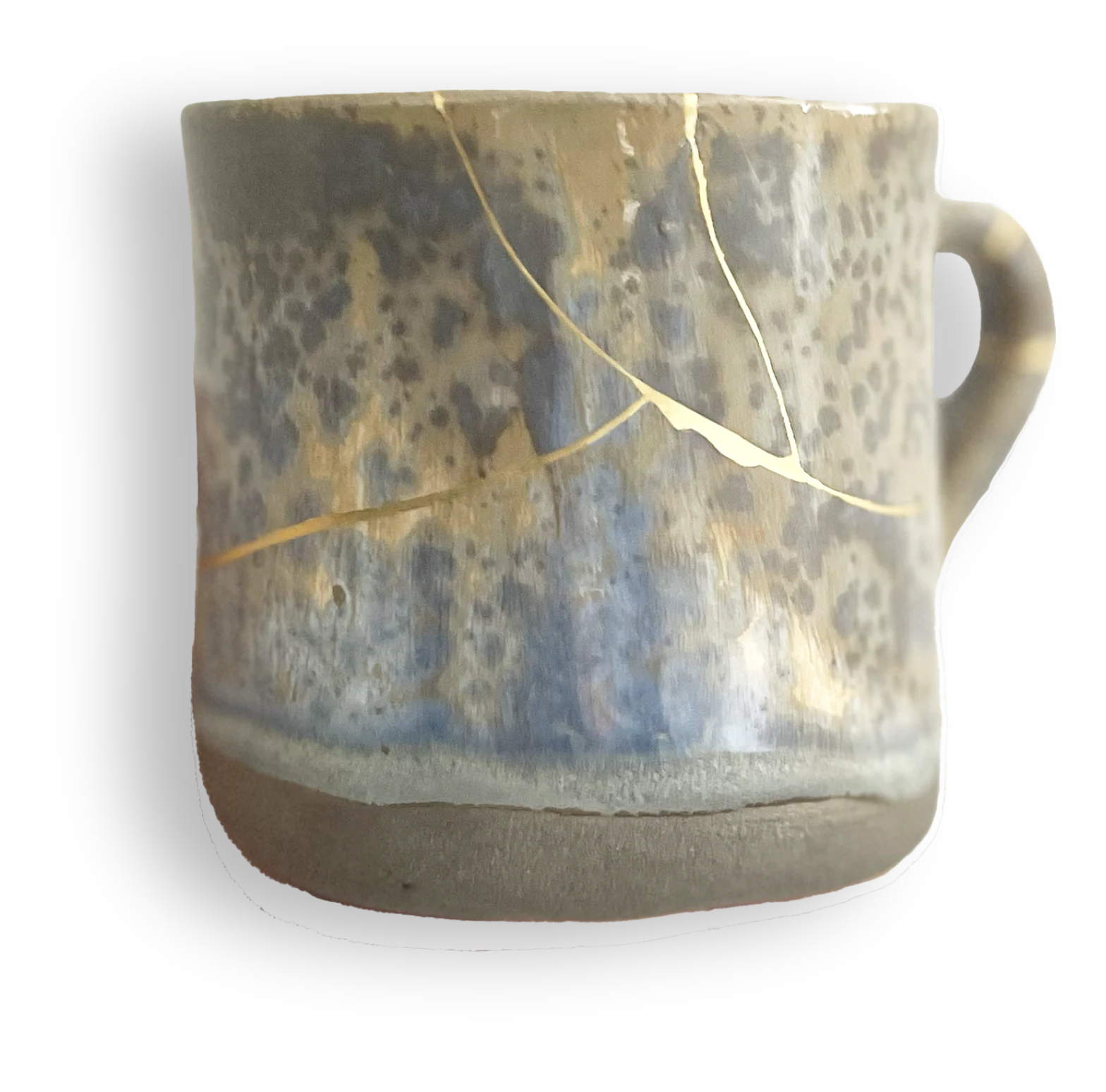
Kintsugi allows damaged pieces to be repaired and used again.
The repaired areas are more delicate, so please treat them with a little extra care. Enjoy their unique character for years to come.
Care 01 | Keep it away from heat
Do not use in a microwave, dishwasher, oven, or over an open flame.
Sudden changes in temperature and exposure to heat may put stress on the repaired areas.
Care 02 | Wash gently
Hand wash with a soft sponge and mild dish soap.
Avoid hard brushes and abrasive cleaners.
Care 03 | Avoid strong impact
Kintsugi repairs are not as strong as the original, undamaged ceramic.
Take care to avoid dropping the piece or knocking it against other objects.
Care 04 | Do not soak for long periods
Avoid leaving the piece submerged in water for an extended period.
After washing, gently wipe away any moisture and allow the piece to dry completely.
Changes Over Time
Part of the beauty of kintsugi is how it can subtly change with use.
Changes in colour and texture can become part of the unique character of your piece. We hope you enjoy how it evolves over time.
However, if you notice any of the following:
- A repaired area appears to be lifting
- A new crack or chip has appeared
- Water is leaking through a repaired area
Please do not press, sand, or attempt to repair the area yourself. Get in touch with us first.
ContactThis guide provides general care instructions. Care requirements may vary depending on the materials used and the condition of each piece. If you have received specific care instructions for your piece, please follow those instructions first.
FAQ
About Your Pieces
Can a repaired piece be used again?
Yes. Traditional kintsugi is a technique intended to repair a piece so that it can continue to be used.
However, repaired areas are more delicate than the original surface. Please take a little extra care when using and caring for your piece.
For repairs using modern kintsugi or brass, please follow the specific care instructions provided for your piece. In general, we recommend enjoying these pieces as art or for display.
Can glass pieces also be repaired with kintsugi?
Yes. Because lacquer does not adhere well to glass, the glass is first bonded with epoxy resin before the kintsugi process. However, repairing glass is more difficult than repairing ordinary ceramic pieces and requires additional steps and care, so the cost may be higher. Please contact us first and include photos that show the condition of the piece.
Can a piece be repaired if some of the fragments are missing?
Yes. We can recreate the missing parts and repair the piece. The appropriate repair method depends on the condition of the piece, so please contact us for a consultation first.
Can you repair pieces other than tableware?
Yes. We can also repair non-tableware pieces such as ornaments and vases. Depending on the material, intended use, and condition of the damage, modern kintsugi may be recommended, and the most suitable repair method will vary.
Can you repair earthenware pots and heat-resistant dishes?
Pieces that are exposed to high temperatures during use require different considerations from ordinary tableware. While they can be repaired, they cannot be used over an open flame or in an oven after repair. Please use them for display or serving only.
About Repairs
Do you also offer simplified kintsugi?
Yes. We also offer simplified kintsugi using epoxy resin instead of natural lacquer, and tin or brass instead of gold.
Depending on the condition of the piece and your preferences, traditional kintsugi may not be suitable. In such cases, we may recommend modern kintsugi or another appropriate method.
Can you repair a piece that I have already repaired with adhesive?
Yes. We can remove the adhesive or use the most appropriate method to carry out the kintsugi repair.
Please do not try to remove the adhesive yourself. Contact us with the piece in its current condition.
Can a piece that has already been repaired with kintsugi be repaired again?
Depending on its condition, a kintsugi repair may be repaired again.
If you notice damage or any concerning changes to a kintsugi repair, please do not attempt to repair it yourself. Contact us first. We will assess its condition and advise you on the most appropriate method.
Before Sending Your Piece for Repair
Where should I send my piece for repair?
After you contact us by email or through our inquiry form to request a repair, we will provide instructions on where and how to send your piece.
Please do not send a piece for repair without contacting us in advance.
How should I pack my piece for repair?
Wrap the piece securely in protective cushioning, such as bubble wrap, so that it cannot move during transit, and always place it in a cardboard box. Please do not send it in a bag.
Place any small fragments in a small bag or other suitable container and seal it securely.
Please do not send any accessories, boxes, or other items that are not part of the piece being repaired.
Can I bring my piece to you in person?
Yes. If you would like to bring your piece to us in person, please contact us in advance.
Can you accept multiple pieces for repair?
Yes. We are happy to discuss repairs for multiple pieces.
Discounts may be available for multiple or ongoing repair requests. Please feel free to contact us.
Is compensation available if my piece is damaged?
As kintsugi involves handling items that are already damaged, we cannot provide compensation for any unexpected damage that may occur during the repair, while the piece is in our care, or during shipping.
Please understand this in advance.
Materials & Allergies
Can lacquer cause a rash?
Fully dried and cured lacquer is generally considered safe, but individual reactions to lacquer may vary. We cannot accept responsibility for any symptoms or reactions related to lacquer.
If you have a severe lacquer allergy, or concerns about materials such as metal due to a metal allergy, please use your own judgment when deciding whether to use the repaired piece.
If you would like to confirm the materials used in your repair, please contact us in advance.
Does kintsugi use real gold?
Yes. The gold powder used for kintsugi is either pure gold (K24) or gold with a purity of K23 or higher.